 admin

Echo Weaver puts a knowledge-based spin on the Metroidvania formula. Instead of making every new area depend on collecting another ability, the game gives players a broad set of powers from the beginning and asks them to learn how to use those tools to move forward. That approach could make observation and experimentation just as important as combat.
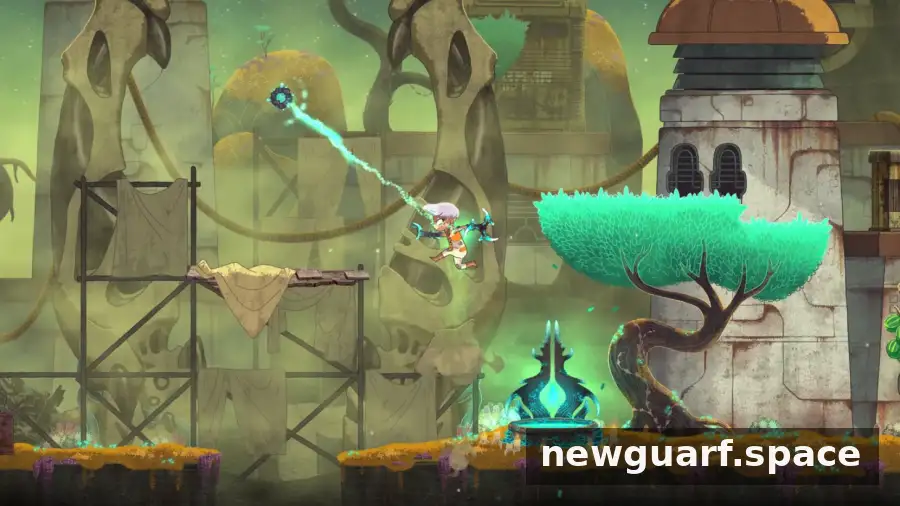
Echo Weaver’s knowledge-first progression
Developed by Moonlight Kids, Echo Weaver follows the last Weaver through an expanding map presented as a side-scrolling world. The game’s central idea is a variation on familiar Metroidvania progression: advancement is described as depending less on gaining new powers and more on understanding the abilities already available. Time manipulation is also part of the design, though the early preview does not detail exactly how every time-based mechanic works.
This structure changes what players should pay attention to. When a route seems blocked, it may be useful to reconsider how an existing move or tool could interact with the surroundings rather than assuming a missing upgrade is required. Taking time to revisit areas and test different approaches may be especially helpful in a game built around learning.
Movement, combat, and the glaive
The Weaver has several built-in movement abilities: a slide, a double jump, a wall jump, and a fast downward dive similar to a ground pound. Together, these moves provide different ways to navigate the environment. For players, a practical first step is to get comfortable with how each action affects movement before attempting more demanding routes or puzzles.
The primary weapon is a powerful glaive that can be thrown and returned in a boomerang-like manner. It supports combat and also plays a role in puzzles. That overlap gives the weapon more than one purpose: learning its behavior may help players both handle enemies and investigate obstacles. In the early hours of the main story, the glaive’s use in puzzles was described as one of the more rewarding parts of the experience.
What to keep in mind while exploring
- Try the available movement abilities in different situations before concluding that a path is inaccessible.
- Consider the glaive as both a combat tool and a way to engage with puzzles.
- Pay attention to the environment and revisit locations when new understanding suggests another route.
- Expect to learn through experimentation; the progression concept emphasizes knowledge rather than a steady stream of newly acquired powers.
Why the approach stands out
Metroidvania games often build exploration around unlocking abilities that open previously unreachable routes. Echo Weaver’s stated premise offers a different emphasis: players begin with their powers and must discover how those powers fit together. The result may appeal to players who enjoy interpreting clues, practicing movement, and solving problems as much as collecting upgrades.
Because the available details come from an early build, the full scope of the map, time manipulation, and progression is not established here. Still, Echo Weaver’s mix of side-scrolling exploration, versatile movement, glaive-based puzzles, and knowledge-focused advancement gives it a distinct hook. For anyone interested in the genre, Echo Weaver is worth watching for how it develops that idea.
