admin
Silent Hill: Townfall brings the series’ psychological horror to a first-person perspective, pairing familiar unease with new ideas from developer Screen Burn, formerly known as No Code. A hands-off gameplay demo at Summer Game Fest Play Days offered a look at its Scottish setting, a handheld television that reimagines the classic radio, and puzzles rooted in everyday technology. Here’s what the preview revealed about the game’s atmosphere and mechanics.
Silent Hill: Townfall and its Scottish setting
Rather than returning to the familiar American town, the game takes place on the Scottish island of St. Amelia. Screen Burn is based in Glasgow, and the setting gives the studio an opportunity to bring local cultural details into the series. The abandoned streets and buildings are rendered using photo scans of real Scottish towns, helping the environments feel grounded even as the horror grows more surreal.
The story follows Simon Ordell, a bespectacled man drawn back to the island by a mysterious woman who appears on his portable television device and asks him to find her. The demo leaves much about Simon and his situation unexplained, but the uncertainty supports the series’ investigative, unsettling tone.
The CRTV replaces the classic Silent Hill radio
Simon’s handheld CRTV is central to both the story and gameplay. Like the series’ traditional radio, it reacts to nearby danger through static. It also occasionally shows video of the woman Simon is searching for. Screen Burn recorded the footage with older cameras and equipment so that the image quality would suit the device and its eerie messages.
The CRTV can also reveal enemy silhouettes through walls, giving Simon information about threats without forcing him to step into view. This makes it useful for planning a route through dangerous spaces. When exploring, pay attention to its signals and use cover before deciding whether to sneak past an enemy or risk a confrontation.
Exploration and grounded puzzles
The demo establishes its atmosphere with silence rather than a constant musical score. Sparse environmental sounds can break that quiet unexpectedly, making careful movement and listening feel important. A town map marks points of interest and includes a legend on its reverse, so checking both sides can help Simon navigate the streets.
Inside a house, Simon finds letters addressed to Zoe Ellis, medical gauze, a flashlight without batteries, and a locked organ transplant container. A framed photograph raises another question when it appears to show Simon himself. These details invite players to inspect rooms closely instead of rushing toward the next objective.
One early obstacle is a dark closet beneath the stairs. Simon needs batteries to use his flashlight, then discovers that the fuse box requires an electricity card. The solution reflects an old Scottish practice described during the demo: buying special cards from stores and inserting them into a panel to activate electricity. It’s a practical tip for players: examine objects and locations for clues before assuming a puzzle depends on an abstract riddle.
Stealth and first-person combat
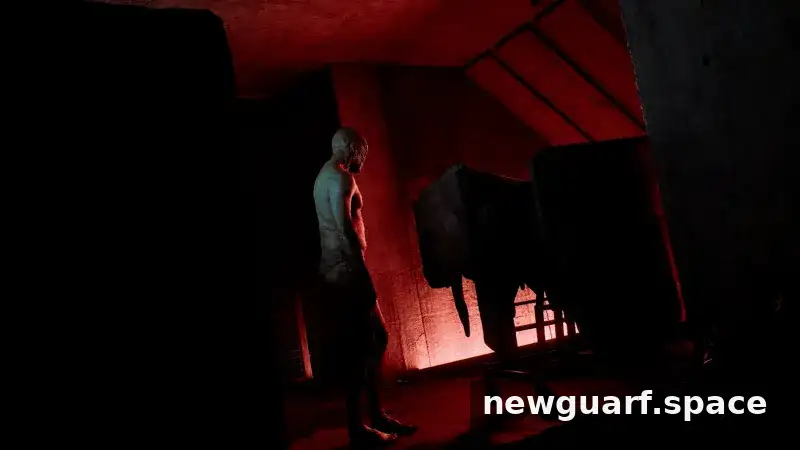
Simon eventually heads to a news store to look for an electricity card. The front entrance is locked, and reaching another way inside brings him into contact with a grotesque, two-legged creature. Its torso is bound with straps, while a metallic rectangle impales its head and gives its silhouette an axe-like shape. Simon has no weapon at first, making avoidance the safer choice.
Players can peek around corners, with Screen Burn describing a more flexible version of the mechanic that allows Simon to look from additional angles while staying concealed. Combined with the CRTV’s enemy silhouettes, this offers more than one way to assess a threat before moving.
After entering the store through a back door, Simon finds an electri-card and a wooden 2×4. The first-person fighting is deliberate and heavy, but the creature is fast and dangerous. Simon is knocked down after a few attacks. He can revive instantly using an IV attached to his left arm, though the demo suggests this ability can only be used once per death. The preview ends before the next encounter’s outcome is shown.
What the preview suggests
The first-person viewpoint makes close encounters feel immediate, while the quiet streets and CRTV build on the oppressive atmosphere associated with Silent Hill. Screen Burn’s focus on believable, technology-based puzzles also offers a distinct angle on the series’ exploration. The demo does not answer what Simon is doing on St. Amelia or why his photograph is in the house, but those mysteries provide clear reasons to keep investigating.
Silent Hill: Townfall is scheduled to launch on September 24. Based on the gameplay shown, its mix of stealth, deliberate combat, environmental clues, and radio-inspired CRTV mechanics could make the first-person shift a compelling fit for the franchise. For players following Silent Hill: Townfall, the most useful details to watch are how the CRTV guides exploration and how often careful observation can help avoid a fight.